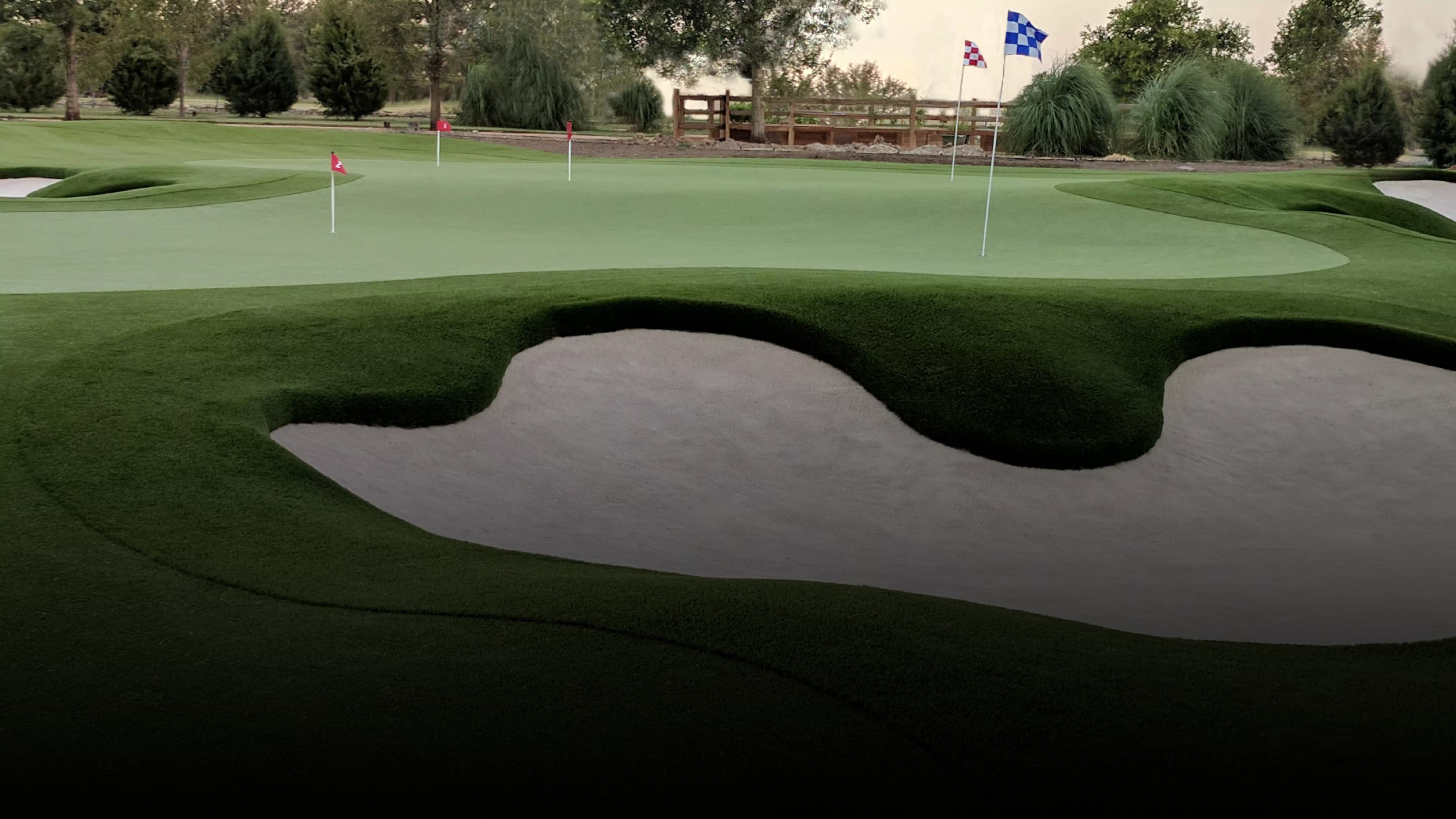
How to Install Gravel Base for
Putting Greens & Artificial Grass
The secret to a perfect lawn lies beneath the surface. Discover the right compacted "1/4 inch - Minus" foundation for water efficiency, longevity, and a flawless roll.
More Than Just Turf
Artificial grass is water, time, and money efficient. But are you contemplating giving your property artificial turf? There are more factors at play than just the green blades you see. You’ll also need a rock-solid underbase.
Most conventional lawns sit on soil, which swells and shrinks during cold, hot, dry, and rainy conditions. If you ignore this sub-foundation, your grass can develop:
- Creases and wrinkles
- Sinkholes or weak patches
- Uneven putting surfaces
The solution? Install a sub-base to replace the natural soil’s vast surface with one that is non-expansive and stable.
The Base Hierarchy
The 3 Types of Sub-Base
Choosing the right material for your specific project
Crushed Miscellaneous Base (CMB)
Composed of recycled concrete or asphalt mixed with sand and gravel ranging from 3/4″ to fine sand.
Best For
- General Landscaping
- Budget-Friendly Projects
- Easy Compaction
Class II Road Base
The most costly variant. Subject to extensive testing and strict standards. Often used for highways and heavy loads.
Best For
- Heavy Traffic Areas
- Strict Code Compliance
- Municipal Projects
Decomposed Granite (DG)
Granite that has eroded into fragile rock fragments, creating a mix of sand, gravel, and silt. Less porous but incredibly smooth.
Perfect For
- Putting Greens
- Ultra-Smooth Surfaces
- Tightest Compaction
Our Recommendation: DG vs. CMB
If you are constructing putting courses with artificial turf, the Decomposed Granite (DG) option is perfect. While CMB is inexpensive and widely used for general landscaping, DG results in a significantly smoother underlying surface.
Think of it this way: A general lawn can handle minor undulations, but a golf ball will deviate off-line with even the smallest imperfection. DG provides that "table-top" finish required for a true roll.
Base Installation Checklist
Excavate
Remove 3-4 inches of native soil. Remove any large rocks or debris that could shift over time.
Distribute
Spread your chosen sub-base (DG or CMB) evenly over the area. Rake it flat to prevent high spots.
Moisten
Lightly water the base. Moisture helps the smaller particles settle into the voids of larger rocks.
Compact
Use a vibrating plate compactor. Go over the area multiple times in different directions until rock hard.